10 Free AI Certifications That Actually Look Good on a Resume
Ten free AI certifications from Google, IBM, Microsoft, and Oracle, converted into a WithMira candidate guide with a proof-first warning.
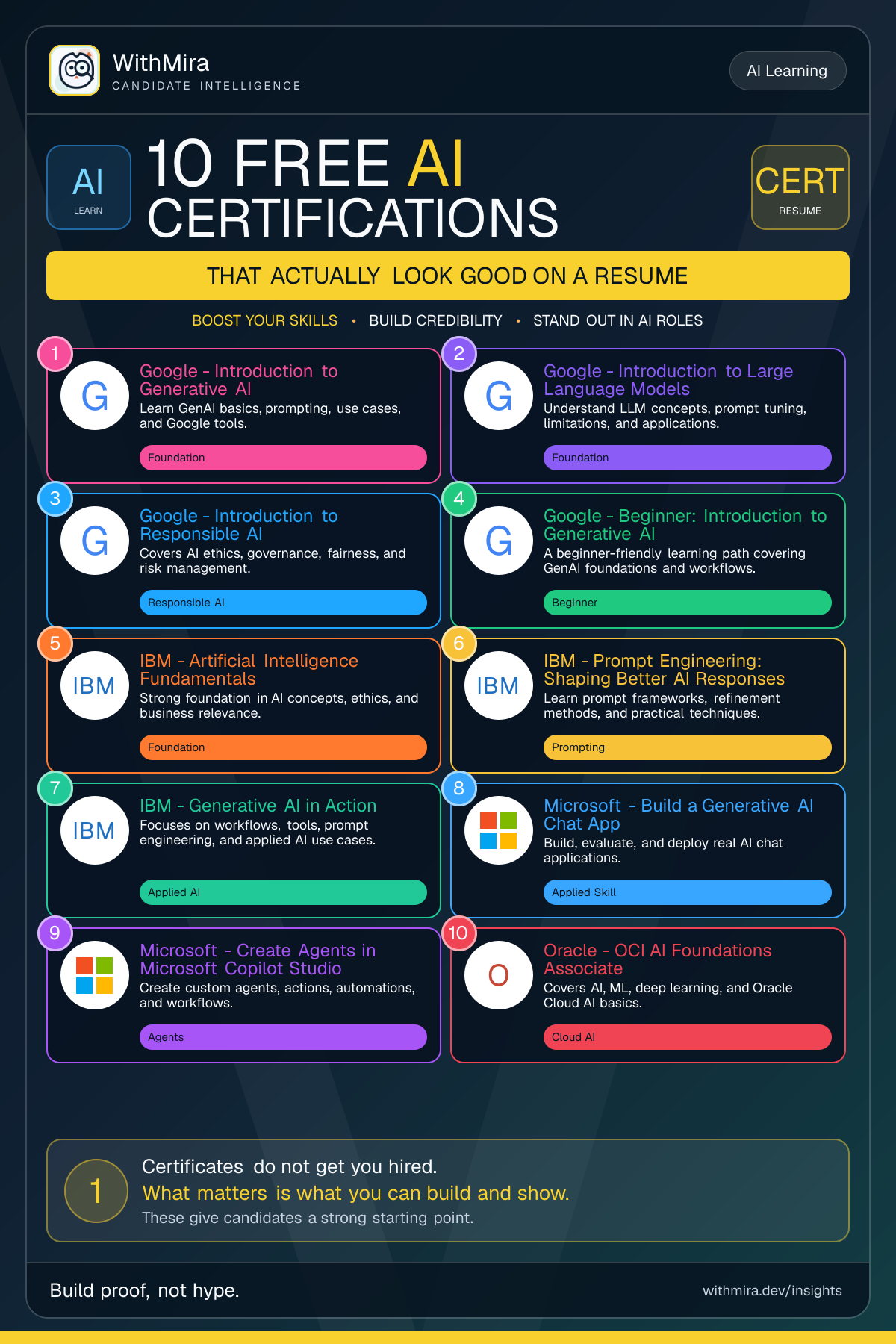
A WithMira version of the popular AI certification cheat sheet: ten free provider-backed courses candidates can use as a starting point.
Why this matters
Certificates do not get candidates hired by themselves, but source-backed courses can help structure learning and make a resume easier to trust when they connect to visible proof. This list covers ten official course or credential paths across Google, IBM, Microsoft, and Oracle, which is enough to compare foundation learning with applied AI work.
The useful move is to treat a course as the start of a project, not the final achievement. A certificate says you completed material. A project says you can use the material without overclaiming it.
How to use the list
Start with foundation courses if you need vocabulary, limitations, prompt design, and responsible AI. Move to applied skills when you can build, evaluate, deploy, or automate something a hiring team can inspect.
The list is not a ranking of provider prestige. It is a decision tool. Google and IBM options are useful for foundations and vocabulary. Microsoft applied skills are stronger when you want a build artifact. Oracle can support cloud-AI literacy when the target role touches cloud platforms.
What to publish after
For each certificate, publish a short artifact: what you learned, what you built, what failed, and how you checked the output. That makes the certificate feel like evidence instead of decoration.
A simple format works: course name, role skill, project artifact, verification method, and one limitation. That final limitation is important because it shows judgment and keeps the claim believable.
Official course links
The share image stays clean. Use the Course references section in this post to open the official Google, IBM, Microsoft, and Oracle course pages before adding any certificate to a resume.
The conclusion
A certificate is useful when it reduces doubt. It should tell the reader what you studied, but the project beside it should show what you can now do.
Choose one foundation course, one applied course, and one artifact. That combination is stronger than collecting ten badges with no story behind them.
Go course by course
Introduction to Generative AI
Learn GenAI basics, prompting, use cases, and Google tools.
Google Cloud Skills BoostIntroduction to Large Language Models
Understand LLM concepts, prompt tuning, limitations, and applications.
Google Cloud Skills BoostIntroduction to Responsible AI
Covers AI ethics, governance, fairness, and risk management.
Google Cloud Skills BoostBeginner: Introduction to Generative AI
A beginner-friendly learning path covering GenAI foundations and workflows.
Google Cloud Skills BoostArtificial Intelligence Fundamentals
Strong foundation in AI concepts, ethics, and business relevance.
IBM SkillsBuildPrompt Engineering: Shaping Better AI Responses
Learn prompt frameworks, refinement methods, and practical techniques.
IBM SkillsBuildGenerative AI in Action
Focuses on workflows, tools, prompt engineering, and applied AI use cases.
IBM SkillsBuildBuild a Generative AI Chat App
Build, evaluate, and deploy real AI chat applications.
Microsoft LearnCreate Agents in Microsoft Copilot Studio
Create custom agents, actions, automations, and workflows.
Microsoft LearnOCI AI Foundations Associate
Covers AI, ML, deep learning, and Oracle Cloud AI basics.
Oracle MyLearnUse the certificate as proof
- Choose two courses that match the role you want, then turn each one into a small portfolio proof.
- Add only completed and relevant certifications to a resume, close to the project or skill they support.
- Pair every certificate with a build artifact: repository, demo, README, architecture note, or walkthrough.
What to remember
Ten free AI certifications from Google, IBM, Microsoft, and Oracle, converted into a WithMira candidate guide with a proof-first warning. Treat the certificate as a starting point. The career signal comes from turning the learning into a project, a demo, or a clearer interview story.
- Certificates help most when they support a portfolio story.
- Foundation courses build vocabulary; applied credentials should lead to a demo.
- Candidates should show what they can build after the course.