Enterprise AI Is Moving From Model Access to Workflows
The latest provider signal is that AI work is moving from model access toward deployed workflows, managed agents, voice interfaces, and enterprise transformation teams.
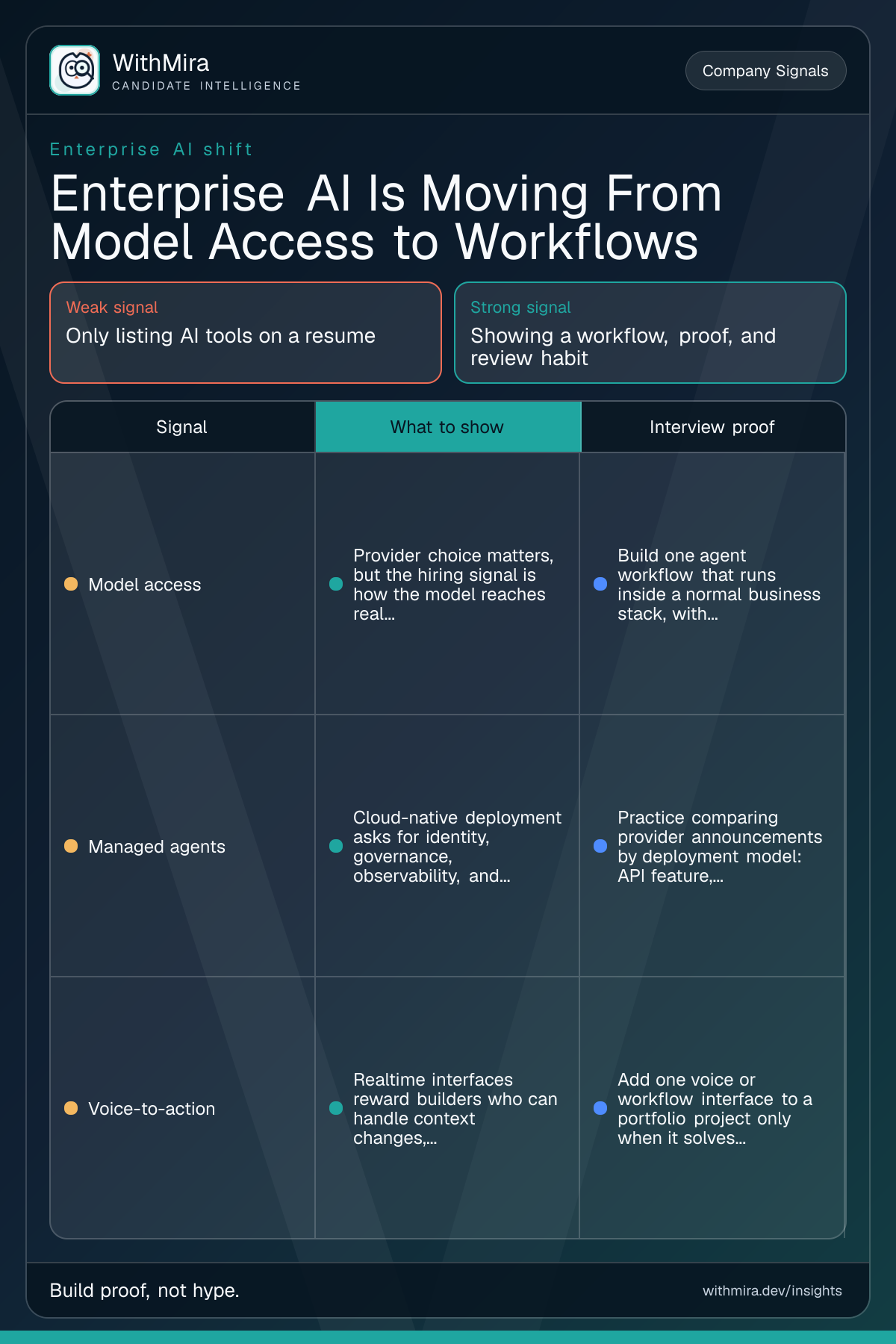
OpenAI and Anthropic are both pushing AI from model access into production workflows, but their latest moves show different routes to enterprise adoption.
The signal
The strongest AI career signal this week is not only a better model. It is distribution. OpenAI is pushing models and managed agent capabilities into cloud environments and realtime voice interfaces. Anthropic is pushing Claude into enterprise delivery through a PwC rollout, a Center of Excellence, and a services company aimed at organizations that need help turning AI into operating practice.
Those are different routes to the same destination: AI is leaving the isolated prompt box and entering the systems where work already happens. The career question is no longer 'which model can answer better?' The question is 'who can safely put that capability into a real workflow?'
The opinion
Candidates should stop treating AI as a standalone chatbot skill. The market is moving toward people who can place AI inside existing systems: cloud governance, identity, procurement, customer support, finance operations, software delivery, and regulated workflows.
The useful skill is not knowing which provider won the week. The useful skill is explaining how a model becomes a safe, observable, cost-aware workflow. That means approvals, logs, role boundaries, exception handling, and a clear reason for using AI in the first place.
OpenAI versus Anthropic as career signals
OpenAI's recent source material points toward platform reach: managed agents in AWS environments and realtime voice interfaces for developers. That favors candidates who can think in deployment models, event flows, latency, tool access, and cloud operations.
Anthropic's source material points toward transformation delivery: trained professionals, systems integrators, and applied teams that redesign enterprise functions around Claude. That favors candidates who can translate a business process into AI-assisted work without losing compliance, ownership, or human review.
The comparison is not winner versus loser. It is platform reach versus operating change. Strong candidates can speak both languages.
What to prove next
A strong proof project should look less like a prompt demo and more like a small operating system for work: a task queue, a tool boundary, source citations, permission checks, handoff states, and a visible audit trail.
If voice is the interface, show interruption handling and tool use. If agents run in the cloud, show environment boundaries and logging. If the use case is enterprise transformation, show how the workflow fits the people already doing the work.
The conclusion is simple: enterprise AI rewards candidates who can make AI boring enough to trust. Build something narrow, reviewable, and tied to a business task; then explain the risks as clearly as the result.
Compare the proof points
Model access
Provider choice matters, but the hiring signal is how the model reaches real users and systems.
Managed agents
Cloud-native deployment asks for identity, governance, observability, and tool-boundary skills.
Voice-to-action
Realtime interfaces reward builders who can handle context changes, interruptions, and tool use.
Enterprise rollout
Large deployments need training, process redesign, compliance, and human approval paths.
References
What to do next
- Build one agent workflow that runs inside a normal business stack, with authentication, logs, approvals, and rollback notes.
- Practice comparing provider announcements by deployment model: API feature, managed cloud service, consulting rollout, or internal workflow.
- Add one voice or workflow interface to a portfolio project only when it solves a real user task, not just because the model is new.
- Prepare an interview story about how you would move an AI prototype into production without losing security, review, or cost control.
What to remember
The latest provider signal is that AI work is moving from model access toward deployed workflows, managed agents, voice interfaces, and enterprise transformation teams. The comparison matters only if it changes a decision: what to learn, what to build, or how to explain your work in a hiring process.
- Provider news is pointing toward workflow delivery, not isolated prompt skill.
- OpenAI's signal is platform reach through cloud and realtime interfaces.
- Anthropic's signal is enterprise transformation through partners and trained teams.
- Candidates should prove production judgment: approvals, logs, boundaries, and business fit.