Official AI Learning Paths Worth Turning Into Projects
A source-first guide to AI learning paths candidates can use to build real proof, not only collect course names.
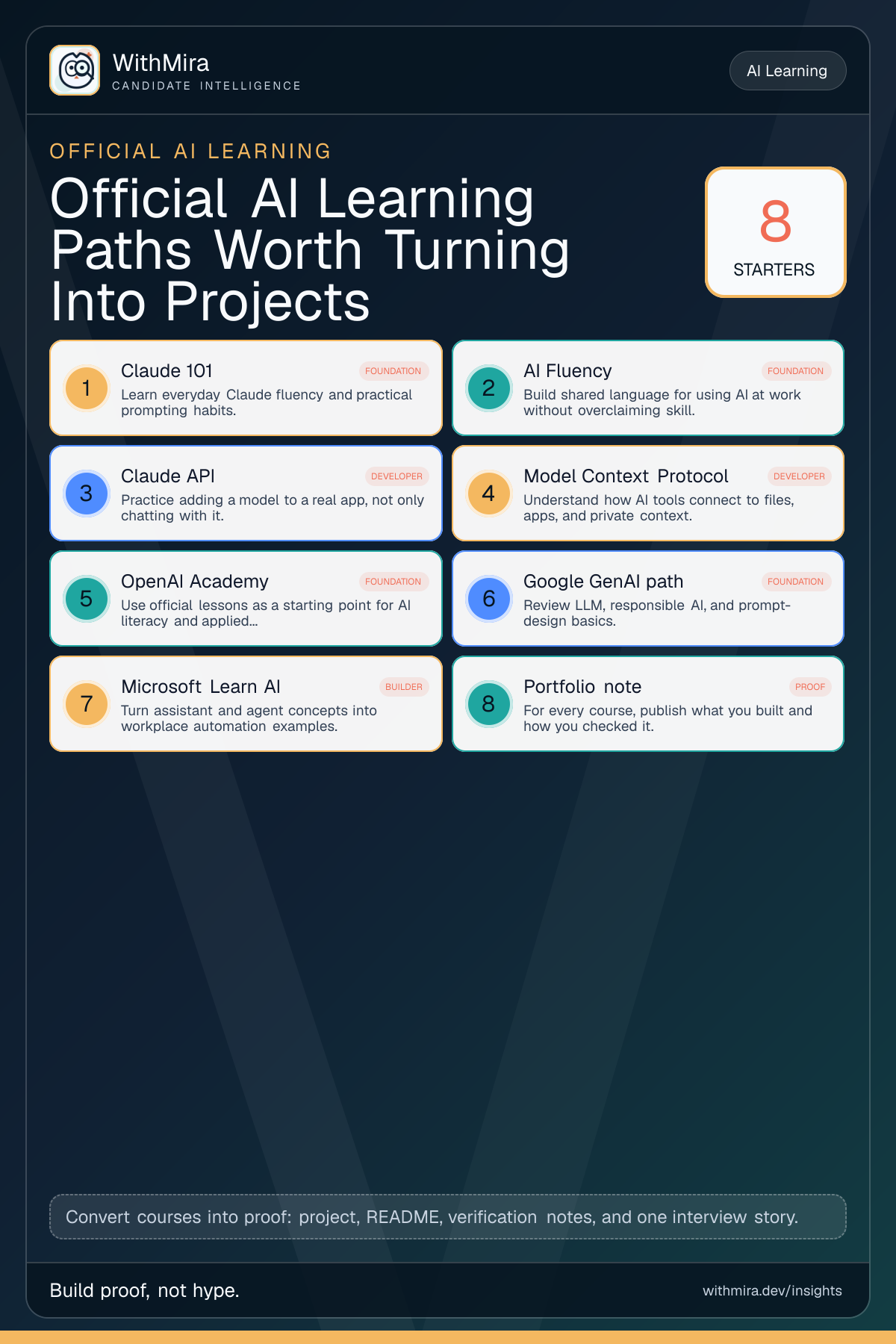
Candidates need practical AI learning paths that point to official material and explain what each course helps them prove.
Why this matters
AI learning content is noisy because the market changes faster than most course catalogs. Official provider material is useful because it starts closer to the product surface: Anthropic for Claude, OpenAI for platform fluency, Google Cloud for GenAI foundations, and Microsoft Learn for applied workplace scenarios.
But the course is only the input. The hiring signal is what the candidate builds after learning it: a small app, a workflow, a README, a recorded demo, or a comparison that shows how the output was verified.
How to choose
Start with foundations if you cannot explain model limits, prompting, evaluation, and responsible use yet. Move to builder material when you can show a concrete workflow such as retrieval, tool use, API integration, or an agent with approval boundaries.
The useful sequence is foundation first, then one applied build, then a short explanation of tradeoffs. Skipping straight to advanced tooling often creates a portfolio that looks impressive but cannot answer basic trust questions.
What to publish
Do not just post certificates. Publish one short project note for each learning block: what you built, what failed, how you checked the output, and what role skill it demonstrates.
A recruiter may not know the difference between two AI courses. They can understand a small artifact: a source-grounded assistant, a Claude artifact, a prompt evaluation table, or a short API workflow with logs. Convert learning into evidence.
The conclusion
The best AI learning path is not the longest path. It is the one that gets the reader from vocabulary to visible proof with the least wasted motion.
Use official training for foundations, then build one artifact that proves the lesson. That keeps the content grounded and gives the candidate something useful to show beyond a completed course page.
Open the source paths
Claude 101
Learn everyday Claude fluency and practical prompting habits.
AnthropicAI Fluency
Build shared language for using AI at work without overclaiming skill.
OpenAIClaude API
Practice adding a model to a real app, not only chatting with it.
Google Cloud Skills BoostModel Context Protocol
Understand how AI tools connect to files, apps, and private context.
Microsoft LearnOpenAI Academy
Use official lessons as a starting point for AI literacy and applied workflows.
OpenAIGoogle GenAI path
Review LLM, responsible AI, and prompt-design basics.
Microsoft Learn AI
Turn assistant and agent concepts into workplace automation examples.
Portfolio note
For every course, publish what you built and how you checked it.
References
What to do next
- Pick one foundation course and one builder course, then turn the lessons into a small portfolio artifact.
- Keep a short learning log with the prompt patterns, failure cases, and verification habits you practiced.
- Prefer official provider material when learning a fast-changing AI platform, then add one independent project.
What to remember
A source-first guide to AI learning paths candidates can use to build real proof, not only collect course names. Use the official paths as structure, then convert the learning into something visible. Hiring teams trust proof more than saved links.
- Official courses are useful when they lead to a project or workflow proof.
- Foundation material helps candidates explain AI limits and responsible use.
- Builder material should end with something a recruiter or hiring manager can inspect.