DevOps Engineer: 90-Day Learning Path
A 90-day DevOps path focused on containers, CI/CD, infrastructure as code, Kubernetes basics, observability, and rollback thinking.
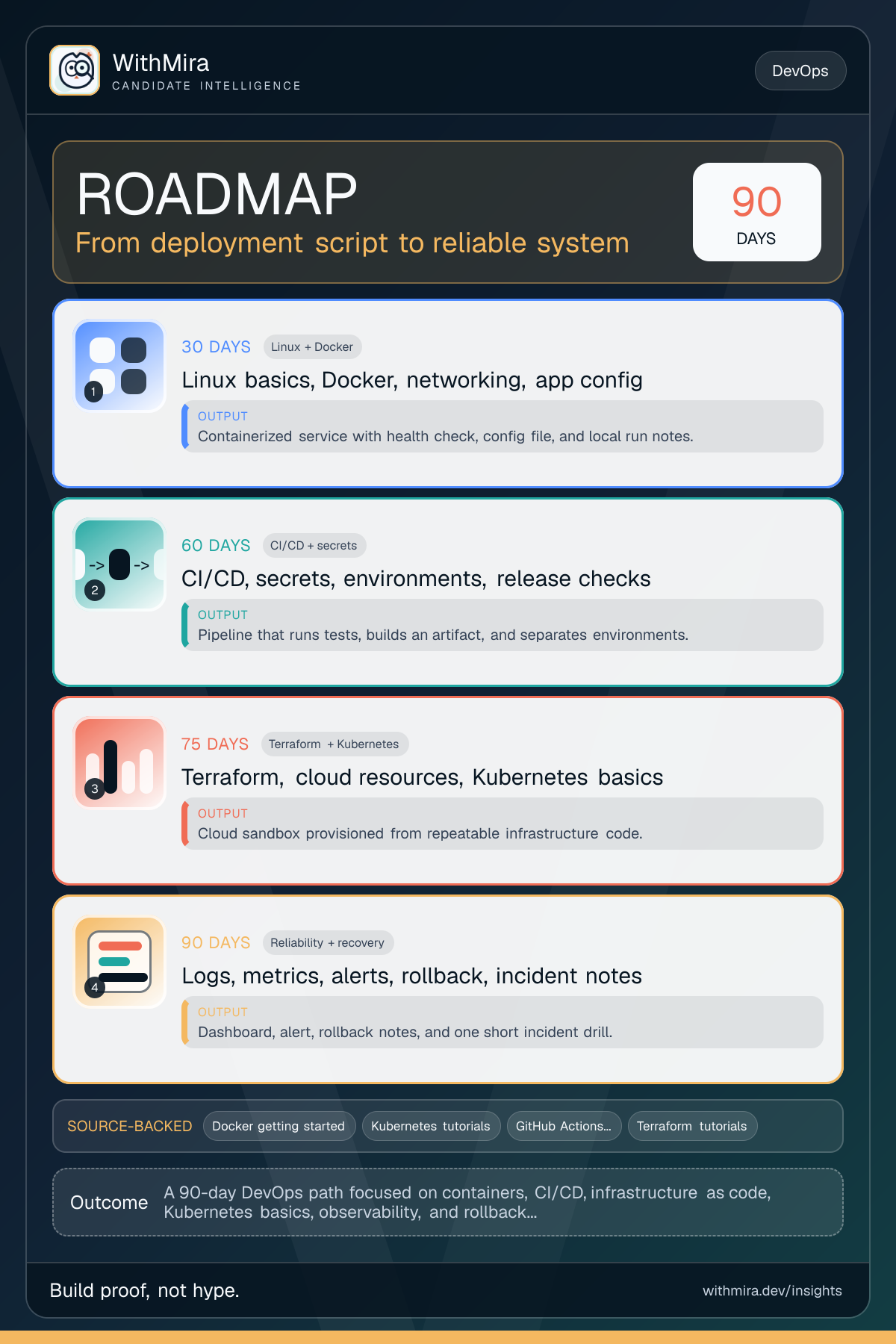
A DevOps learning path for candidates who want to show deployment, infrastructure, automation, and reliability judgment.
Why this path works
DevOps roles reward candidates who can connect application delivery to infrastructure, automation, observability, and recovery. The strongest portfolio signal is not a diagram alone. It is a working deployment path with logs, health checks, and clear operational tradeoffs.
The market does not need another resume that lists Docker, Kubernetes, and Terraform without context. It needs evidence that the candidate can ship a small service, keep it running, and explain what happens when it breaks.
What to learn first
Start with Linux and containers, then add CI/CD, infrastructure as code, cloud fundamentals, Kubernetes concepts, monitoring, and incident response habits. Candidates do not need to run a large platform to show judgment. They need one small system that can be deployed and explained.
The right 90-day path moves from local repeatability to automated delivery, then to infrastructure, then to recovery. Each step should answer a real operator question: how do I run it, release it, configure it, observe it, and roll it back?
What to prove
A credible DevOps project shows how code becomes a running service, how configuration changes by environment, how secrets are protected, how failures are detected, and what rollback path exists.
A short incident drill makes the project much stronger. Break one dependency, capture the alert or log, describe the diagnosis, and show the recovery path. That turns a tools project into an operations story.
The conclusion
DevOps learning becomes credible when it shows delivery and recovery in the same story. Anyone can say they know a pipeline; fewer candidates can explain what happens after a bad deploy.
Build the smallest system that can fail visibly and recover cleanly. That is the kind of proof that makes the roadmap feel real.
Follow the path step by step
30 days
Linux basics, Docker, networking, app config
60 days
CI/CD, secrets, environments, release checks
75 days
Terraform, cloud resources, Kubernetes basics
90 days
Logs, metrics, alerts, rollback, incident notes
References
What to do next
- Containerize one small app and deploy it through a CI pipeline with environment-specific configuration.
- Add infrastructure notes that explain rollback, secrets, health checks, logs, and cost boundaries.
- Practice incident-style thinking: what breaks, how you detect it, and how you recover safely.
What to remember
A 90-day DevOps path focused on containers, CI/CD, infrastructure as code, Kubernetes basics, observability, and rollback thinking. The roadmap works when each phase produces evidence. A smaller finished artifact beats a long learning plan with nothing public to inspect.
- DevOps proof should show delivery, configuration, monitoring, and recovery.
- One small deployed service can demonstrate more than a long tool list.
- Reliability thinking is part of the skill, not an advanced extra.