AI Systems Made Simple: LLM, RAG, Agents, and MCP
A simple mental model for AI systems: LLMs generate, RAG grounds, agents act, and MCP connects tools and context.
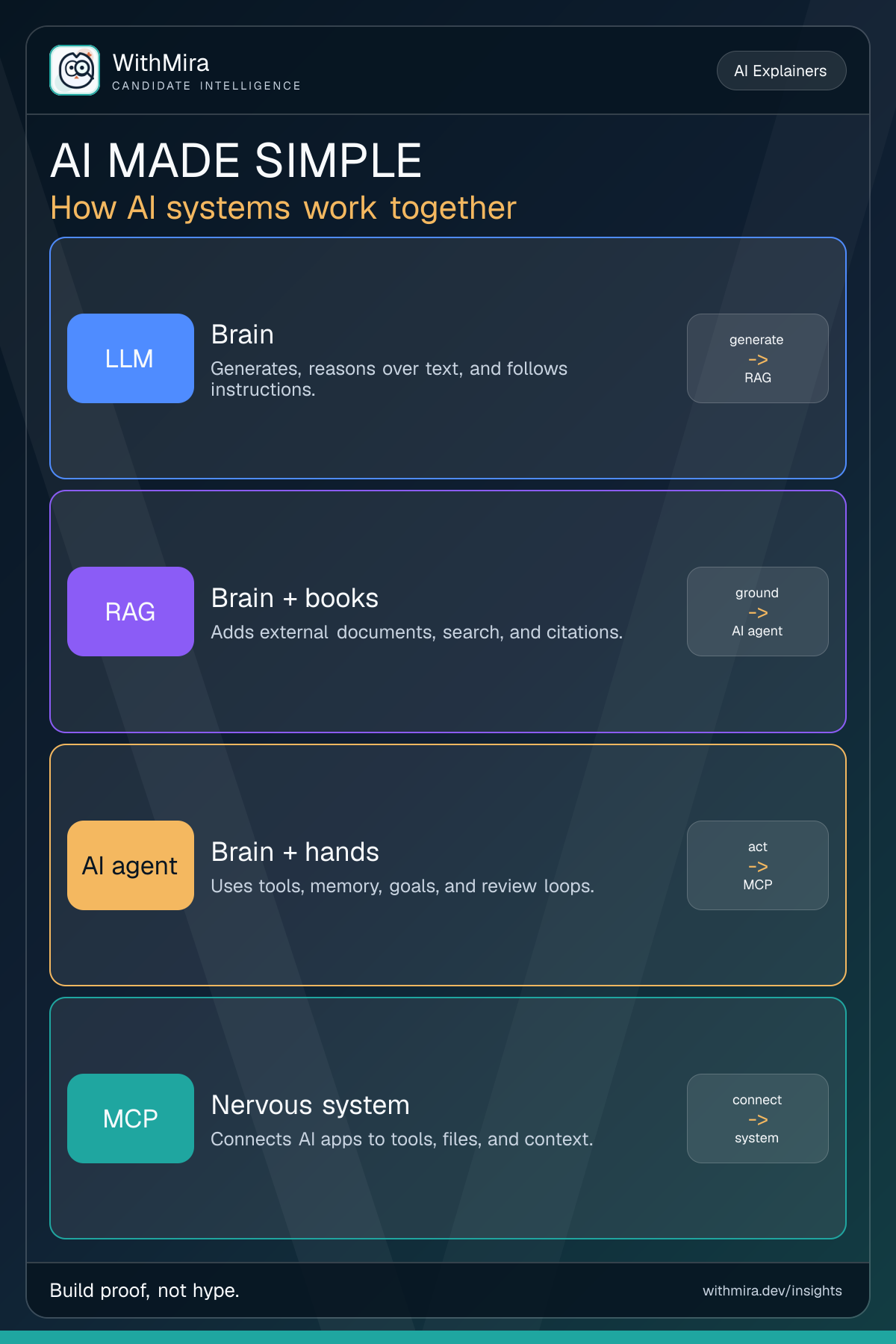
A plain-language explainer for candidates who need to understand how LLMs, RAG, agents, and MCP fit together.
The simple model
An LLM generates and reasons over language. RAG gives the model external knowledge and citations. An agent adds goals, tools, memory, and action loops. MCP is a standard way to connect AI applications to tools and context.
The terms are often mixed together because they appear in the same product demos. For a candidate, separating them is useful. It shows you understand whether the problem is generation, grounding, action, or integration.
Why candidates should care
These terms appear in product, support, data, platform, and engineering work. Being able to explain the differences helps candidates avoid vague AI claims and talk clearly about architecture, risk, and proof.
If the answer needs company documents, talk about retrieval and citations. If the system takes action, talk about tools, permissions, and review. If the problem is connecting private systems, talk about integration boundaries and protocols.
What to prove
A credible project can be small: a document Q&A app with citations, an agent that drafts but waits for approval, or a workflow that logs every tool call and lets a person review the output.
The point is not to use every term at once. The point is to show that you know which part of the system solves which problem. That is the architecture judgment hiring teams can evaluate.
The conclusion
LLM, RAG, agents, and MCP are useful labels only when they help the reader make a design decision. Otherwise they become noise.
Use the mental model as a diagnostic: does the system need generation, grounding, action, or integration? The answer tells you what to build and what risk control to add.
Understand each layer
LLM
Generates, reasons over text, and follows instructions.
RAG
Adds external documents, search, and citations.
AI agent
Uses tools, memory, goals, and review loops.
MCP
Connects AI apps to tools, files, and context.
References
What to do next
- Practice explaining LLM, RAG, agents, and MCP in plain language before using those terms on a resume.
- Build a small RAG demo with citations, then add one tool action only after the retrieval step is reliable.
- Document the boundaries: what data the system can access, what it can do, and where approval is required.
What to remember
A simple mental model for AI systems: LLMs generate, RAG grounds, agents act, and MCP connects tools and context. The mental model is only valuable if you can use it in plain language. Practice explaining the system, then prove one piece with a small build.
- LLM, RAG, agents, and MCP are different pieces of an AI system, not interchangeable buzzwords.
- The career signal is explaining how the pieces work together and where trust controls belong.
- Small projects can prove architecture judgment better than broad AI claims.